
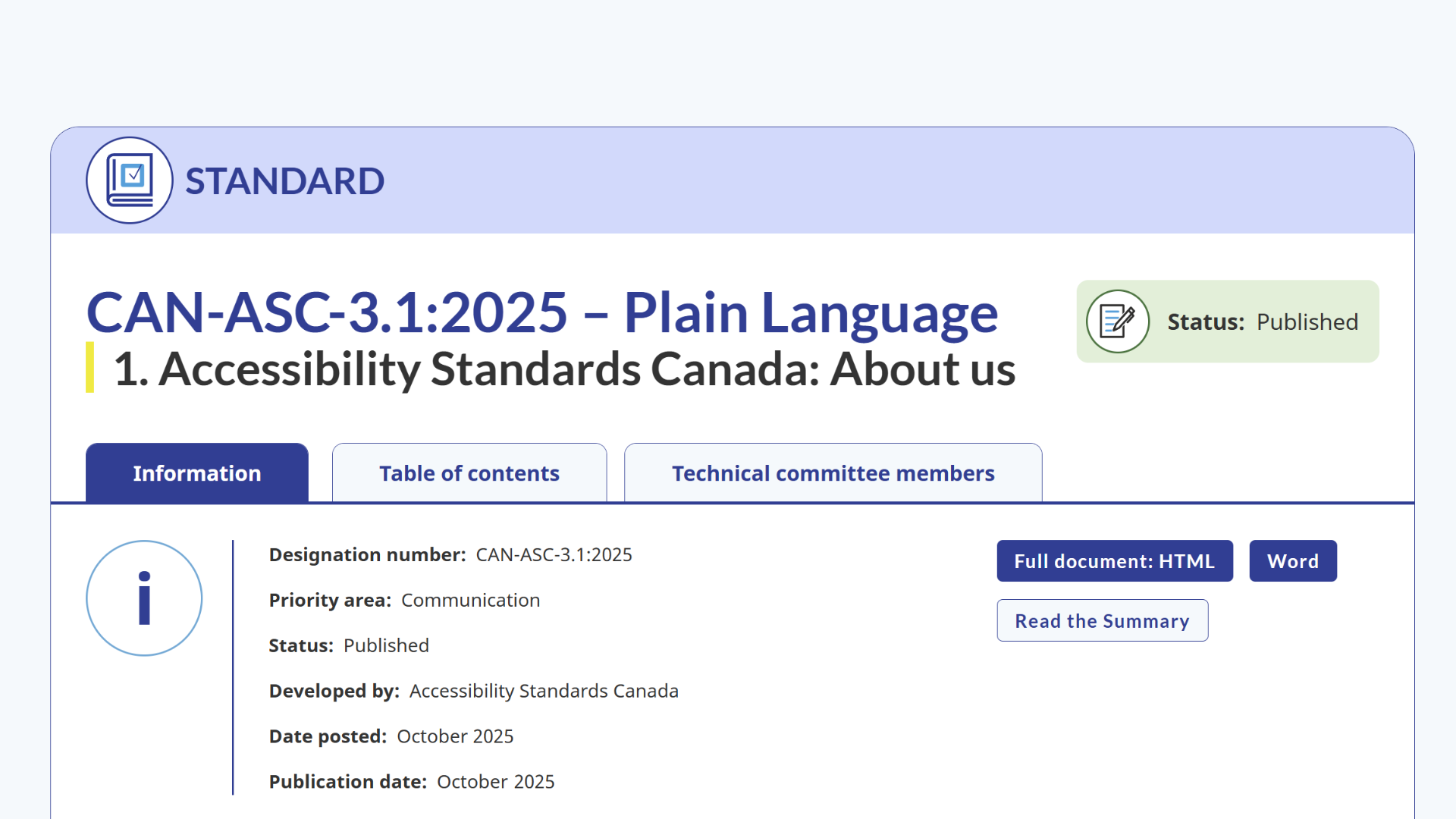
In October 2025, Accessibility Standards Canada published CAN-ASC-3.1:2025, the first National Standard of Canada on plain language. It’s free, available in English and French, and approved by the Standards Council of Canada.
The standard treats plain language as an accessibility issue. Not a writing preference. Not a style choice. An accessibility requirement.
What plain language means under this standard
The definition:
A communication is in plain language if its wording, structure, and design are so clear that the intended audience can easily find what they need, understand what they find, and use that information.
Three things to notice: wording, structure, and design. All three must be clear. A well-written paragraph buried in bad layout doesn’t qualify.
Who developed it
A technical committee of 17 members. The majority were people with disabilities and members of equity-deserving groups. The committee included plain language consultants, accessibility specialists, researchers, and government communications professionals. The standard went through a full public review before approval.
Six categories of communication barriers
The standard identifies six types of barriers that prevent people from accessing information:
- Complex, lengthy, or dense content that reduces understanding
- Emotional and distress-related barriers that interfere with comprehension
- Information access and navigation barriers (can’t find or follow the content)
- Visual, hearing, and format barriers (no alternate formats available)
- Digital and interactive accessibility barriers (content doesn’t work with assistive technology)
- Barriers caused by language, literacy, or unfamiliar terminology
These categories apply to websites, printed documents, social media posts, videos, braille, and any other format used to communicate information.
What the standard requires
The standard uses “shall” for requirements and “should” for recommendations.
Five core areas:
Audience (Clause 10). You shall identify your intended audience, learn about the barriers they face, and consult with them throughout development. Multiple audiences may need separate communications.
Evaluation (Clause 11). You shall test your communication with members of your intended audience before publishing. Desktop reviews and expert reviews alone are not enough. You should also evaluate after publication.
Structure (Clause 12). You shall organize information in a structure that is as simple as the audience needs. Titles and headings must be brief and accurately describe what follows.
Wording and expression (Clause 13). You shall choose words the intended audience already knows, understands, and uses. Unfamiliar or specialized terms must be explained. Numbers must be expressed in the clearest form for the audience.
Design (Clause 14). Typography, contrast, colour, layout, visuals, and tables are all plain language concerns. Design must help the audience find and understand the information.
How it connects to other standards
The standard explicitly aligns with:
- CAN/ASC-EN 301 549:2024: Canada’s ICT accessibility standard (referenced in the new digital accessibility regulations)
- ISO 24495-1:2023: The international plain language guideline
- The Accessible Canada Act
- The Government of Canada’s Directive on the Management of Communications
- The Canadian Charter of Rights and Freedoms
- The UN Convention on the Rights of Persons with Disabilities
Canada is one of the few countries with a formal national plain language standard.
Voluntary (for now)
The standard is currently voluntary. Organizations can adopt it in whole or in part. But Accessibility Standards Canada can recommend it to the Minister responsible for the Accessible Canada Act for incorporation into regulation. If that happens, it becomes mandatory for federally regulated entities.
Why this matters for web content
WCAG and EN 301 549 cover the technical side of digital accessibility: markup, contrast ratios, keyboard support. They don’t fully address whether the content itself is understandable. This standard fills that gap.
Federal digital accessibility regulations take effect December 2027 for public sector organizations. Those regulations require conformity with EN 301 549. The Plain Language Standard complements that by addressing content quality, the part the technical standard doesn’t cover.
If you publish web content for Canadian audiences, this gives you a concrete, citable framework.
The standard is available in HTML and Word formats at no cost.